
.jpg)
 |
| Image via Troy Denning's Goodreads Page |
Lightsaber Rattling (LR): Your new novel Crucible is billed as a last hurrah for the Big Three heroes of Star Wars. It seems like throughout the Expanded Universe we have spent a great deal of time with Han, Luke and Leia, but not all three of them on adventures a lot. What was the appeal of writing Crucible to you and focusing on these three characters on an adventure together?
Troy Denning (TROY): One of the real appeals was the chance to write them together. One of the things I struggled with in the plot was how to bring them together as much as I possibly could. Eventually I had to realize that I coudn’t have all three together in every scene — or even the majority of scenes — because that just didn't work. When you try to push things into a story that just don’t fit, the story won’t end up feeling natural.
Coincidentally, the only other standalone I wrote for Star Wars was Tatooine Ghost. That was my first chance to use Chewbacca, and the first time he had been used in a book since Vector Prime. So I wrote my first draft and had Chewbacca in every scene. I was way over-using him, to the point that when my wife read it, she looked at me and said, ‘You know what; the family furball doesn't have to be in the room every time Han and Leia are.’ So I kind of learned my lesson from that.
LR: You mention Tatooine Ghost, How do you approach writing a story differently when you are writing a stand-alone book differently versus when it is part of larger series or is part of your own Trilogy (like you’re Dark Nest Trilogy)?
TROY: The biggest difference is the brain storming. When you work on a series, you are brainstorming with a lot of other people. You often get together in a room start tossing ideas around. Enthusiasm builds, and you build on each other’s ideas. You have a lot of fun, coming up with ideas and laughing.
That is really truly a treasure for any writer, because we spend so much time alone.
When you are doing a standalone, you need to do all of that brainstorming yourself. So it feels a little more like serious work.
LR: When you are doing a stand-alone book, how much of the story and plotting do you bounce off the editors before you submit a manuscript?
TROY: Basically, it works about the same, whether it is a standalone or a series. The process is just a little bit different. You start by coming up with an idea and writing the editor an email — which is ideally short and succinct, but rarely actually is. This email describes the idea and says, ‘Hey, this is what I am thinking of doing, what do you think?'
It allows the editor to have a reaction to the kernel of an idea before you spend two to three weeks working on an outline. Once you come up with a kernel that works for everyone, you go back and write an outline and go through the same process again.
When you are doing a standalone, you need to do all of that brainstorming yourself. So it feels a little more like serious work.
LR: When you are doing a stand-alone book, how much of the story and plotting do you bounce off the editors before you submit a manuscript?
TROY: Basically, it works about the same, whether it is a standalone or a series. The process is just a little bit different. You start by coming up with an idea and writing the editor an email — which is ideally short and succinct, but rarely actually is. This email describes the idea and says, ‘Hey, this is what I am thinking of doing, what do you think?'
It allows the editor to have a reaction to the kernel of an idea before you spend two to three weeks working on an outline. Once you come up with a kernel that works for everyone, you go back and write an outline and go through the same process again.
Once you write the outline, then you write the manuscript. While you are writing the manuscript, new ideas occur to you and ideas don't work that you thought were great. So, as you’re writing, you stay in touch with the editor, and say ‘this is working, this isn't working, and I’ve got this idea.’ Bounce it off the editor and the team at Lucasfilm and make sure you don't surprise anybody with anything that is going to be a big problem to undo. Just so everyone stays on the same page through the whole process.
My rule of thumb about what I bounce off them while writing is: `Can I undo it in half an hour?’ So if I have an idea and it is something that is going to change three or four chapters, I'll bounce it off of them. If it's something I put out there and can undo with a "change all" or deleting a few lines here and there, then I let them read it fresh the first time.
LR: I have read a previous interview you did for StarWars.com years ago in which you discussed your writing process and the concept of a "character cross." For our readers I wonder if you could describe the process a bit and perhaps take a character from Crucible as an example.
TROY: Basically, it's a simplified version of how I set up the skeleton of a character. I approach designing a character from the basic idea that every character has two sets of basic attributes. They have a primary strength and a primary weakness, and they have a primary desire and a moral "do not cross" line (a statement of what a character would refuse to do to achieve his goals). For example, would they murder somebody? If they would, that tells you a lot about the character — and if they wouldn't, that tells you a lot about the character, too.
I set it up so that I know what a character is capable of physically, mentally and emotionally — and how far he is willing to go to get what he wants. Usually, I'll actually write it on a sheet of paper, with strength at the top of the vertical axis and weakness at the bottom, with goals on the horizontal axis and the moral line on the other.
Let's take Han, because he is one of my favorite characters and he is a pretty obvious case. Han's strength is his resourcefulness; he can keep up with the Jedi even without the Force. He is a clever and quick witted guy. His weakness is he is pretty impulsive. He goes off half cocked a lot of the time. His primary desire can change from story to story, but usually it has something to do with protecting someone or something he loves. His moral line concerns loyalty. He would never betray a friend or a loved one. That's really a pretty simplified version of how I design a character. Once I have that I start to write the character, and the actual writing of the character is what fleshes everything out. This gives me some idea of who they are to begin with.
LR: Looking back at your Star Wars books in particular, I'm not sure if you drew the short straw or you go the meaty assignments where you got to kill off two of the Solo sons, Anakin in Star by Star and Jacen in Invincible. Do you have some Qreph like vendetta against Han Solo, I know you said he was one of your favorite characters?
TROY: Well, you know the old folk saying —you hurt most the ones who you love the best. But, joking aside, I think it’s really just a matter of proximity. I’m always writing about Han and Leia, so that means that the bad things that need to happen in a story are happening to them. It’s the curse of being my favorite characters, I guess.
LR: On a serious note did you ever experience the sort of fan backlash that R.A. Salvatore did after the death of Chewbacca in Vector Prime?
TROY: Sure, that happens. But there are hundreds of thousands of Star Wars readers out there, people who just want to read the books and have fun. If one or two of them are disturbed enough to send menacing notes over a character death, it can be pretty unnerving, but it’s not all that surprising — not when you’re dealing with a population that large. To some extent, it goes with the territory. You just have to deal with it and try not to take it too personally.
LR: For the most part have fan reactions to your works been pretty positive?
TROY: For the most part, pretty positive. But I would be insincere if I didn't acknowledge that I can be a polarizing author for Star Wars. Some of that is due to things I’ve done of my own volition, and some of it’s just due to the assignment I drew. But you have to write from your heart and write what you think is true to the story. That's what I always try to do. On the few occasions where I’ve been asked to do something I didn’t I feel I could make work, the editors and everybody else have proven to be very reasonable, and we’ve arrived at solutions that worked for everybody.
And it's good to work that way, because if you’re working at alone (as most authors do), it’s easy to grow very myopic very quickly. A good example would be the Jaina-Zekk-Jag love triangle of the LotF series. I kept thinking that Jaina and Zekk ought to end up together, but Aaron and a couple of editors seemed to prefer Jag. So we went back and forth about that in emails and story meetings, and eventually ended up resolving the issues I had -- which were that I didn't want to see Jaina going off to live with Jag somewhere other than the Jedi Temple, because I didn't want to lose her as a character.
In my view, Jaina is a vital character to the future of the whole EU, and whenever anyone said she should be with Jag, I kept having images of her being ripped from my writing life forever. I guess I was identifying with Han Solo a bit too much there. 'You're not going to take my daughter away. She's going to live here in my Jedi Temple forever.’
But once we worked out a way to bring Jag to her and make him a part of the Jedi Order, I was very happy to see Zekk move on and write Jaina and Jag’s wedding at the end of Apocalypse.
LR: I know in the past we have heard about George Lucas setting certain story boundaries regarding characters and character deaths. When plotting Crucible did Lucasfilm or Del Rey give you any directions on whether or not you could kill off Han, Luke, Leia, or Lando? And did you even want to?
TROY: Basically, when you are asked to write a story or given the opportunity to write a story, they will give you a goal. That goal can be something very simple, like with Dark Nest: `write three books set sometime in this time period (Post-NJO) and tell us what you're think you’d like to do.’ Or it can be something very complex, like it was with Star By Star: `we want you to write a book set in the middle of this huge series. Here’s a list of plot points, give us an outline that accomplishes them.’
LR: Looking back at your Star Wars books in particular, I'm not sure if you drew the short straw or you go the meaty assignments where you got to kill off two of the Solo sons, Anakin in Star by Star and Jacen in Invincible. Do you have some Qreph like vendetta against Han Solo, I know you said he was one of your favorite characters?
TROY: Well, you know the old folk saying —you hurt most the ones who you love the best. But, joking aside, I think it’s really just a matter of proximity. I’m always writing about Han and Leia, so that means that the bad things that need to happen in a story are happening to them. It’s the curse of being my favorite characters, I guess.
LR: On a serious note did you ever experience the sort of fan backlash that R.A. Salvatore did after the death of Chewbacca in Vector Prime?
TROY: Sure, that happens. But there are hundreds of thousands of Star Wars readers out there, people who just want to read the books and have fun. If one or two of them are disturbed enough to send menacing notes over a character death, it can be pretty unnerving, but it’s not all that surprising — not when you’re dealing with a population that large. To some extent, it goes with the territory. You just have to deal with it and try not to take it too personally.
LR: For the most part have fan reactions to your works been pretty positive?
TROY: For the most part, pretty positive. But I would be insincere if I didn't acknowledge that I can be a polarizing author for Star Wars. Some of that is due to things I’ve done of my own volition, and some of it’s just due to the assignment I drew. But you have to write from your heart and write what you think is true to the story. That's what I always try to do. On the few occasions where I’ve been asked to do something I didn’t I feel I could make work, the editors and everybody else have proven to be very reasonable, and we’ve arrived at solutions that worked for everybody.
And it's good to work that way, because if you’re working at alone (as most authors do), it’s easy to grow very myopic very quickly. A good example would be the Jaina-Zekk-Jag love triangle of the LotF series. I kept thinking that Jaina and Zekk ought to end up together, but Aaron and a couple of editors seemed to prefer Jag. So we went back and forth about that in emails and story meetings, and eventually ended up resolving the issues I had -- which were that I didn't want to see Jaina going off to live with Jag somewhere other than the Jedi Temple, because I didn't want to lose her as a character.
In my view, Jaina is a vital character to the future of the whole EU, and whenever anyone said she should be with Jag, I kept having images of her being ripped from my writing life forever. I guess I was identifying with Han Solo a bit too much there. 'You're not going to take my daughter away. She's going to live here in my Jedi Temple forever.’
But once we worked out a way to bring Jag to her and make him a part of the Jedi Order, I was very happy to see Zekk move on and write Jaina and Jag’s wedding at the end of Apocalypse.
LR: I know in the past we have heard about George Lucas setting certain story boundaries regarding characters and character deaths. When plotting Crucible did Lucasfilm or Del Rey give you any directions on whether or not you could kill off Han, Luke, Leia, or Lando? And did you even want to?
TROY: Basically, when you are asked to write a story or given the opportunity to write a story, they will give you a goal. That goal can be something very simple, like with Dark Nest: `write three books set sometime in this time period (Post-NJO) and tell us what you're think you’d like to do.’ Or it can be something very complex, like it was with Star By Star: `we want you to write a book set in the middle of this huge series. Here’s a list of plot points, give us an outline that accomplishes them.’
Once you have a goal, they give you the parameters — what you’re allowed to do and what you’re not allowed to do. Sometimes you just kind of know it, but sometimes it is spelled out pretty explicitly. For instance, in Star by Star you couldn't violate anything that was going on in the bible (the series’ story bible), anything that had come before, or anything they intended to follow. So there were a lot of parameters there.
With Crucible, the parameters were basically: we don't want to kill the big three. That was established from the beginning. And I'm not sure that if someone had asked me to kill Han or Leia Solo, that I'd have been able to do it. I've killed my fair share of Solos. So even if that had been in the cards, I don’t that I would have agreed to do it.
LR: It seems like you come pretty close to killing them?
TROY: You know I do. I definitely put people through the ringer. That’s because I don’t think the violence should come easily in a story, that minimizes the horror of it. It needs to hurt a little bit, there needs to be consequences.
LR: In Crucible we see Leia dealing with some darker emotions than we traditionally get from her. Do you think this speaks to a jadedness that her character has acquired after all of the loses she has suffered or does it speak to the intensity of her passion and love for Han and the thought of his pain and loss? Or both?
TROY: I think it's her passion and intensity for Han, though it's a bit of both. She has had so much ripped from her. She has sacrificed two children and an untold number of friends to the good of the galaxy. When she starts to fear that she’s going to lose Han, I think she goes down to a darker place than Leia has ever gone before.
I'm saying dark for Leia — which is nowhere near Jacen-dark. She is willing to go with a little more grit and gray morality than she usually is. I know when I wrote it, it felt very natural. It was a function of just how much she loved Han, and just how much she didn't want to lose him.
The title of the book is Crucible and one of the goals was to put them through a crucible on every level. That is kind of her emotional crucible: what she thinks is going to happen to Han.
LR: Speaking of the crucible some critics of the book will dwell on the scenes of extreme physical damage and torture that you put the main characters through. Can you talk about the purpose that these scenes serve?
TROY: Well as you pointed out, it is a crucible. I wanted to put them through a physical crucible, an emotional crucible and a spiritual crucible. The damage they take is pretty much the physical crucible. Throughout their careers, these characters have taken a lot of physical damage, but they’ve also had the resources to be healed from that damage. Luke and Leia have the Force, in Han's case we have all kinds of medicine like Bacta that just aren't available to us. So they take a lot of damage and can heal from it.
What I was trying to get across here was the idea that even after your injuries heal, the damage still takes a toll. I know in college I played Division III football and I could recover from a sprained ankle in a week. But when I turned 35 and was doing Judo and Kyuki-do and would sprain an ankle, it would seem like three weeks to recover. So as you get older, even though you recover, it takes a little more out of you. I wanted to show that.
I also wanted to show them coming to the realization that they needed to slow down and enjoy life, before their old injuries really leave them hurting – before they have so much arthritis that going for a hike just won’t be any fun.
LR: You wrote the concluding the last series Fate of the Jedi: Apocalypse. Towards the end of that book you set up a variety of plot threads for future use, some of which you picked up in Crucible. I am curious to know how close from when Apocalypse was written to when Crucible was announced did you know you would be writing Crucible?
TROY: I think I was asked to write Crucible after I finished Apocalypse. So I pretty much wrote Apocalypse as a wrap to that series, without any idea of what book I would be writing next — or even if I would be writing a book next. On this level, every Star Wars book you write could be your last. So I always approach it that way, especially at the end of a series.
My goal with Apocalypse was to open up the number of story possibilities, as wide as I could. I wanted whoever was writing in the EU next to be able to write any kind of story they wanted and have it fit. So they wouldn't be hamstrung by having the Jedi tied to the government of the Galactic Alliance, so they would have more freedom to do the kinds of stories that would feel more natural for an order of monks or commandos, or whatever your own personal view of the Jedi Order is.
LR: One of the coolest concepts that I think you introduced was the Quest Knights and the search for Mortis. Where was the inspiration for that, is it Arthurian?
TROY: It was basically an Arthurian inspiration. That was one of the story seeds I wanted to plant. I was thinking it might make a really neat series of books. Now we will see.
LR: Regarding Mortis and the explanation given on the TV show, did they give the authors more information than we got as the audience?
TROY: They gave us a little bit of information before I wrote Crucible, while I was plotting it. We had a few more exchanges with Dave Filoni, in which I learned a little bit more about the nature of Mortis and the nature of Monoliths in general. Crucible reflects what he said.
By the way, in my acknowledgements, my handwriting must have been bad, because the typesetter put Dave Eidoni instead of Dave Filoni. So it really is Dave Filoni I am thanking for the information on monoliths. My apologies to Dave.
LR: Of the various plot threads or characters you have spilled into the universe are there any you would be itching to tackle in a future novels if you got the chance?
TROY: There are plenty of them I would love to tackle. In the beginning of Crucible I tossed off like three story ideas, I would love to tackle any one of them.
I would like to write some of Jaina's generation of Knights, Tahiri and so forth, as they come into their own as leaders of the next generation of the Jedi Order. I just think there is going to be a whole golden era of Jedi Knight stories coming in the EU, and I would love to be part of that, if it comes to pass. That of course is a big if with Episode VII. We will just have to wait and see.
LR: You bring up Tahiri, and she is one of my favorite characters coming out of the New Jedi Order. In your portrayal of her she seems to have really turned the psychological corner. Do you think she ever gets a happy ending? And might it be with a certain asteroid tug captain?
TROY: Ha! In my mind she and Omad were definitely having a little bit of a flirt. So I think that’s within the realm of possibility. Part of the goal of this novel was a passing of the torch. As part of that I wanted to show Tahiri being ready to pick up her part, being ready to take a leading role in the next generation. So that was one of the reasons I wanted to bring her in as a supporting character, over anyone else. To have a chance to show her as finally being recovered from what had happened to her in the NJO and Legacy of the Force.
LR: Going back to the big three for a second, Can we talk about Luke's wound for a second? Is the reader to interpret that slow healing nature of the wound and the fact that we at one point see an eye popping out of Luke's insides represents the fact that a piece of Abeloth is still alive inside of Luke and should we expect an alien-esque explosion scene at some point?
TROY: I don't think we are going to get Aliensfrom it. No, Abeloth isn't physically inside him, I didn't mean to imply that at all. Spiritually she is. I don't think Luke is really going to be whole, until or unless the Dagger (Dagger of Mortis) is found and Abeloth is permanently dealt with. The battle in Apocalypse really did wound him on a spiritual level.
It took everything out of him. When you think about that wound, we need to remember Abeloth is a very important part of the Balance. What does dealing with her permanently, ridding the Balance of her renewing chaos actually mean for Luke and for the galaxy? That is one of the stories that I was thinking might be told in the post-Apocalypse future.
LR: When you speak of the balance, do you mean what it means when you eliminate one side of the balance or as Abeloth as the personification of evil?
TROY: Abeloth isn't really a personification of evil, she is a personification of chaos and renewal. If you want to think of her in terms of Hindu mythology, the goddess Kali would be a lot closer to who she is. She is the one that destroys life so life can be reborn. The question for the dagger story, then, would concern what happens when you interrupt that saga. By preventing things from being destroyed, do you also prevent them from growing?
So, that’s the question for Luke. You know he is still wounded by his struggle with her, and he will be until he comes to terms with what interrupting that cycle means. That's really what the wound is about.
LR: In Crucible you introduce a character named Savara Raine, who you pretty quickly reveal is actually Vestara Khai. Can you talk about why you made the revelation so early in the story instead of holding it off for a later reveal?
TROY: That was actually a question that one of the editors brought up. If you’re a careful reader of previous books, in this one you are tipped off to Savara’s true identity just about the first time that someone sees her physically. We talked about whether we wanted to hold that secret back, and my ultimate feeling was that it would be unfair. I hate nothing worse than reading a mystery novel where the author holds back a crucial clue — just doesn't put it out there — until it’s is convenient for the story.
In this case, we had a character looking at Savara and describing her physically, and the little scar in the corner of her mouth is one of the big giveaways of who she is. I felt that if I just failed to mention that, I would be playing unfair, cheating in my attempt to use her. Then, once I decided to put that in her description, I didn't feel like artificially pretending that most readers wouldn't know who she was. When I write and when I play poker, I try not to hold any cards up my sleeve.
LR: As a fan I am curious about your thoughts on the announcement that we will be getting a new Star Wars trilogy as well as new stand alone Star Wars movies.
TROY: I was astonished, because I found out the same way as everybody else. I was delighted we are going to get three new movies, and it sounds like we are going to get even more. Pretty quickly it began to sink in that this means that a whole bunch of issues that are crucial and central to my life are going to be put on hold. Then I realized I would just have to be patient and accept that there probably wasn’t going to be a whole lot of new material for a while.
LR: How do you feel thinking that Crucible could represent one of the last or one of the last significant chapters in the Expanded Universe as it exists now?
 TROY: That’s a question that is hard to answer because we just don't know what the EU is going to end up being. When I was writing Crucible, it was with the idea that it would be passing the torch to the next generation of Jedi. Then of course, the (Disney) purchase goes through, and all of the sudden we don't know exactly what ‘passing the torch’ means. My first instinct was to over think everything. To sit down and try to figure out what was going to happen, and how I could adjust for it. What does this mean for the ending of the book, should I try to link into it? I did everything. I read the scuttlebutt. I analyzed. I got out my Ouija board. Ultimately, I realized — and Shelly Shapiro helped me realize — we just can't know. We just write the book we intended.
I don't think I ever really contemplated it being the end cap of the EU, or the possible end cap of the EU, until it was published and people started to talk about that. I’m in as much suspense as everyone else as to whether that will actually end up being its function. But if it is I will be flattered and privileged. It is always a privilege to write any Star Wars book.
LR: As an author, going forward do you think that the Star Wars franchise would benefit from a reboot of the Expanded Universe, or do you think there is room for an Alternate Universe where the current continuity can exist separately from the continuity that is changed by the new Star Wars films?
TROY: I don't know that we can even go there until we know what Episode VII brings. We are over thinking the situation, trying to plan for contingencies we just can't plan for.
My first and foremost priority is that the movie people have the freedom to write a damn good movie. That's my primary goal, I want to see great movies. I think ultimately that is going to be the thing that strengthens the Star Wars universe and readership the most.
Whatever they need to do to achieve that is fine with me.
There are plenty of things in the EU that they could draw from, and I would be delighted to see that. I think most fans would be delighted to see that. But I don't want the movie people to be hamstrung. The EU is huge. Even when writing a novel, there are so many things you need to dance around, and sometimes that is a bit to the story’s detriment. I don't want to see them having to do that with the movies. I want to see them write the best dang movies they can. Whatever that ends up being, I'll be happy with it.
If that means the EU continues as it is now, I'll be great with that. If they write a movie that means we have to make some modifications to the EU, I'd be happy with that. If they write a movie that means, we need to start over and produce an new EU, then I’ll support them in that.
I am not sure about doing an alternate universe. I don't know that I would automatically think that was the best thing. I don't want to see the readership splintered. I think that might ultimately weaken the franchise rather than strengthen it. But the movie might change my opinion on that. The movie could come out and do something that makes an AU a natural thing to do.
LR: Do you think Han, Luke, Leia can ever stay retired?
TROY: I think that they may not be in charge of things, but they will be having fun no matter what they are doing. Han gets into trouble at the drop of a hat, Leia can't resist trying to make the galaxy a better place, and Luke still has a lot of things he needs to deal with. In my own mind, they are going to be off having adventures of a more personal nature. but whether those end up being adventures people write books about, I don't know. But I doubt they’ll be running the Jedi Order again — they really have passed the reins off to the next generation.
LR: In addition to Crucible do you have any other projects Star Wars or otherwise that you would like to mention to fans who appreciate your Star Wars works?
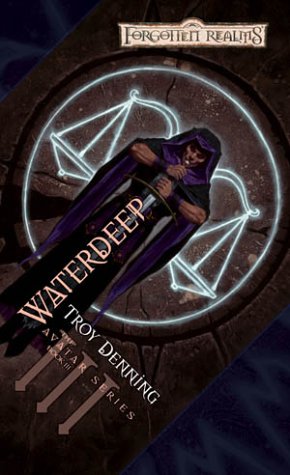
TROY: I am returning to the Forgotten Realms, where I wrote my first book ,Waterdeep, to do a very special project called The Sundering. Two other Star Wars authors are involved in that, Bob Salvatore with The Companions, which kicks it off, and Paul Kemp, who follows him with the second book in the series, The Godborn. I am writing the fifth book, called The Sentinel. That is a very special project that I just couldn't say no to, because of who is involved. Bob has been one of my oldest friends, and Paul I have worked with and enjoyed very much in Star Wars. Ed Greenwood is involved and I've known him forever, and there are a couple of new faces I have just met: Richard Lee Byers and Erin M. Evans. So it’s a blast, and I am having a lot of fun with that.
 |
| Characters from The Sundering series |
Author's Note: A special thanks to Random House's publicity department for facilitating this interview.




 Posts
Posts

