Showing posts with label Book Reviews. Show all posts

Friday, August 30, 2013

Review: The Companions (The Sundering Book 1) by R.A. Salvatore


In R. A. Salvatore's latest novel The Companions, he once again returns to the world of Dungeons & Dragons' Forgotten Realms. This latest story launches a new event called "The Sundering" which spans not only the fictional universe told in the novel but also across the Dungeons & Dragons games.  

Wizards of the Coast Description of The Sundering:
What is the Sundering?
The Sundering will reshape the Forgotten Realms, involving the whole pantheon of gods, many nations, countless individuals, and the fabric of the cosmos itself. Powerful forces both mortal and divine are set in motion, and will bring an end to the Era of Upheaval. Over the course of this huge story event, players will have the opportunity to help shape the future of Faerûn and make their story legend. 
Discover the ways you can experience the Sundering, including through tabletop roleplaying game adventures, store-based play programs, novels, accessories, and the first free-to-play D&D mobile game. 
The end of the Era of Upheaval is nigh!
The world of the Forgotten Realms has endured one catastrophe after another for the past century or so, from the Time of Troubles through the Spellplague. Time after time, upheaval has reshaped the pantheon, overthrown nations and rulers, and even altered the geography of the world. Now, the world is being shaken and reshaped once again—for the last time. 
The gods are thrown into chaos at the promise of a new reckoning of the pantheon, and they scramble and grasp at power in hopes of cementing their positions of authority. Their mortal agents in the world, the Chosen, are charged with carrying out their will in every aspect of life.
The Spellplague, the magical catastrophe that reshaped the world so dramatically, has come to an end. The Weave of magic is rewoven, and many lingering effects of twisted magic fade. The intermingling of worlds brought about by the Spellplague also comes to an end, as what belongs to Abeir returns to Abeir, leaving the Forgotten Realms looking much as it did before. 
Partly driven by the activity of the gods’ Chosen and partly arising from the turbulent political situation at the end of the Era of Upheaval, the nations and factions of Faerûn engage in their own maneuvers, manipulations, and acts of aggression. In particular, the empire of Netheril attempts to conquer the Dalelands, Cormyr, and Myth Drannor, setting off a war that engulfs the eastern Heartlands. The Harpers and the Zhentarim respond to the growing threats in the world by regrouping and refocusing their energies, slowly returning to their former prominence. 
Nations, geography, magic, and even the gods are changing forever, in the birth-pangs that herald a new creation. The world needs heroes to ensure that the new age dawns bright and full of hope, where good still shines as a beacon against the darkness. 
The Sundering series is a six book event, in order they are The Companions, by R.A. Salvatore, The Godborn, by Paul S. Kemp, The Adversary, by Erin M. Evans, The Reaver, by Richard Lee Byers, The Sentinel, by Troy Denning, and The Herald, by Ed Greenwood. For more information on The Sundering you may want to read interviews with R.A. SalvatoreErin M. Evans and Troy Denning and a post form Paul S. Kemp.

Review of The Companions:

Pardon the pun, but I always appreciate it when an author takes a novel approach to a novel. In The Companions R.A. Salvatore doesn't tell another adventure of Drizzt Do'Urden, even though Drizzt is the subject of the novel's cover.  While Drizzt isn't the star of the novel he is the essential heart of the story,The Companions focuses on the story of three of Drizzt's closest friends and allies, Regis the halfling, Bruenor the dwarf King, and Catti-brie, Drizzt's human wife and adopted daughter of King Bruenor. Together these friends along with Wulfgar and Drizzt formed a fellowship known as "The Companions of the Hall."

The Sundering fast forwards the world of the Forgotten Realms approximately 100 years in the future.  Many of the heroes and villains that have populated the novel world are dead and The Companions of the Hall are no exception.  While Drizzt has survived this leap forward in time his closest friends are all dead, but they don't have to be. Catti-brie presents her fellow companions with an opportunity presented to her by patron goddess Mielikki, Catti-brie, Bruenor, Regis, and Wulfgar if the so choose can be reborn, to return to Icewind Dale to come to the aid of their dear friend Drizzt.  But this rebirth is not without price, they will be reborn as infants and have to live a new life until their appointed meeting some 22 years later.

The novel tells the story of Regis, Bruenor and Catti-brie as they are reborn, arriving in to new parents in new locations and meeting a host of new characters.  I loved the concept of having these mature heroes be forced to experience childhood and adolescence anew.  Salvatore's story features these character retaining their memories from their previous life and it was particularly fascinating to see the adult consciousnesses wrestle with the physical desires and emotions of their early childhood bodies.

Each character faces different challenges and takes different paths in their re-birth, though I would say Regis had the easiest time adapting to his new circumstances, Catti-brie was in between and Bruenor had the most trouble adapting.  I was particularly drawn to Bruenor's story as the humors story telling of little infant Arr Arr gives way to the story of an angry adolescent dwarf. Bruenor suffers a crisis of faith and regrets greatly his decision to return for a good portion of the story.

Each character develops new relationships or faces new situations that pull on them emotionally, for Regis it is the chance at a new life and a new love, for Bruenor it is the chance to reclaim his thrown and protect his realm from the imminent threat of Orc invasion and fix what he views as a mistake from his past life, and for Catti-brie it is a new familial bond with new parents.  Catti-brie's love for Drizzt seems to be her singular focus in life and provides her with more clarity of purpose than Regis or Bruenor who are much more conflicted in their reborn lives. I think that this spectrum of experiences paints a very nice picture and while the heroes of this novel all take different paths to fulfill their promise, they all do so.

The Companions is really all about loyalty, friendship and love.  There is no overarching villain that needs to be conquered, their are no grand battles, this is the story of three journeys, about three lives lived and the varied victories and defeats that occur along the way until these friends can reunite as companions.

Salvatore has a number of cliffhanger chapter breaks throughout the novel in which our heroes are left seemingly on the verge of death, this technique is used with each character and serves to heighten the dramatic tension.  While there is a number of fun action scenes in the novel particularly featuring Regis, there are also times where some of the potentially more interesting action happens offstage, particularly on Bruenor's final climb through the north to meet his friends and what occurred to Drizzt just before his appearance in the novel.

As a relatively new reader to the Forgotten Realms universe, my only previous experience being Paul S. Kemp's two Erevis Cale trilogies, there are some references I am sure I missed in this novel.  I didn't have the benefit of knowing the back story of Drizzt and his friends or knowledge of some of the other regions and history of the worlds.  All that being said, The Companions worked for me as a stand-alone novel, though I think my enjoyment was greatly enhanced by my previous reading that gave me at least a feel for the rules and realities of this universe.  By telling the story of the heroes being reborn Salvatore is able to use the perspective of each character through memories, internal and external dialogue and occasionally the discussions of third parties to give us a window into the shared history of these characters.

All that being  said, I really enjoyed The Companions, though it definitely is a story that begs for a follow up, what will the Companions do now that they are reunited?

For more on The Companions, visit Wizards of the Coast and to read a sample of the book visit R.A. Salvatore's website.

Author's Note: A digital review copy was provided by the publisher via NetGalley for this review.

Tuesday, August 20, 2013

Review: Star Wars: Kenobi by John Jackson Miller (Minor Spoilers)


Let's cut to the chase. Just go buy (pre-order) Kenobi now and thank me later.

Kenobi is not space opera, but it is Star Wars.  It is a story told on a much smaller scale that focuses on building characters, making and braking relationships.  Under the harsh and unforgiving twin suns of Tatooine, Miller tells the quintessential Obi-Wan Kenobi story.  

The Republic has fallen.Sith Lords rule the galaxy.Jedi Master Obi-Wan Kenobi has lost everything . . . Everything but hope. Tatooine—a harsh desert world where farmers toil in the heat of two suns while trying to protect themselves and their loved ones from the marauding Tusken Raiders. A backwater planet on the edge of civilized space. And an unlikely place to find a Jedi Master in hiding, or an orphaned infant boy on whose tiny shoulders rests the future of a galaxy. Known to locals only as “Ben,” the bearded and robed offworlder is an enigmatic stranger who keeps to himself, shares nothing of his past, and goes to great pains to remain an outsider. But as tensions escalate between the farmers and a tribe of Sand People led by a ruthless war chief, Ben finds himself drawn into the fight, endangering the very mission that brought him to Tatooine. Ben—Jedi Master Obi-Wan Kenobi, hero of the Clone Wars, traitor to the Empire, and protector of the galaxy’s last hope—can no more turn his back on evil than he can reject his Jedi training. And when blood is unjustly spilled, innocent lives threatened, and a ruthless opponent unmasked, Ben has no choice but to call on the wisdom of the Jedi—and the formidable power of the Force—in his never-ending fight for justice.

I don't think it is a coincidence that two of the best novels in recent memory were also probably the two stories that were the longest in terms of development by the authors.  I put Kenobi on par with Darth Plagueis in terms of quality and what it adds to the grander Star Wars mythology.  While the two books are much different in tone and content, there is a quality and loving craftsmanship that shines through in both works. Plagueis was a book that was announced, cancelled and the subsequently brought back to life.  Kenobi is a book that originally started as a graphic novel story idea and was shelved and later developed in it's current form.

Kenobi also follows the recent trend in Star Wars publishing of genre hopping. This is very much a western told in the Star Wars universe.   The basic premise will be familiar to fans of the western genre. Mysterious loner drifts into town, trying to mind his own business.  Instinctual acts to protect a victim from an attack. The victim becomes a friend and the loner is put in a position that he has to protect this new friend against the threat. 

The story in Kenobi is told from a few point of views, we have Obi-Wan, a Tusken Raider warlord, a moisture farmer/militia leader, and a shopkeeper.  The story centers around a frontier community on Tatooine, the bright center of which is Danner's Claim.  The Claim is a one stop frontier shop, it features of mercantile, a saloon/restaurant, storage, offices and repair shops.

We meet Obi-Wan Kenobi early in his return to Tatooine at the beginning of his watchful self-exile.  The novel brilliantly balances the internal struggles that Obi-Wan faces as he tries to adjust to the new realities of his life with the external struggles that he faces in the novel.  

Fans of Superman will pick up on the very strong Clark Kent vibe that infuses the character of Obi-Wan Kenobi in this novel.  This fits nicely with the humor of Kenobi.  One of the reasons that Ob-Wan is one of my favorite Star Wars characters is his sense of humor.  A humor hinted at by Sir Alec Guinness in the original trilogy, given full form by Ewan McGregor in the prequel trilogy, and further refined by James Arnold Taylor in The Clone Wars animated series. 

Kenobi's humor stands in start contrast with the guilt and pain that the character of Obi-Wan is drowning. This humor provides an emotional grounding for the character and speaks to an underlying optimistic nature. 

One of the overriding themes in Kenobi is how relationships not only create bonds but create burdens.  The Jedi were bound to the Republic and thus had a duty to defend it in The Clone Wars, Obi-Wan was bound as padawan to his Master Qui-Gon and thus felt duty bound to fulfill Qui-Gon's dying wish that he train Anakin.  Obi-Wan was bound to Anakin as a Master and a friend and was thus duty bound to confront him on Mustafar and stop the evil that Anakin had become.  As a Jedi and as a friend of their parents, Obi-Wan was bound to Luke and Leia, choosing the burden of protecting the boy from the Emperor's clutches. From one simple relationship between Qui-Gon and Obi-Wan, all of these events and relationships spring that shape the course of Obi-Wan's life.  

This theme of relationship created burdens is echoed in the experiences of the shopkeeper Annileen Calwell, the Tusken war leader, A'Yark, and the moisture farmer Orrin Gualt.  All of whom have relationships and duties that force them to make choices and take actions.  Sometimes these burdens become larger than the underlying relationship would justify.  This pushes our characters to their breaking points and we see their true characters revealed.

This brings me back to one of the other qualities that I love about the Obi-Wan character. Obi-Wan is a man of honor, he will always do his duty no matter the personal cost. At the same time he doesn't cut himself off from relationships and emotions but feels these choices. Life continuously takes it's pound after pound of flesh from Obi-Wan, yet he perseveres.  This makes the character at once both very human in his weaknesses and very super-human in his ability to overcome them. 

Miller crafts some truly enjoyable characters in this novel, the miserly and paranoid moisture farmer Wyle Ulbreck is an absolute riot.  Miller populates the Claim with a cast of characters that are unique and feel organically developed to the setting of the story.  Even some of these back ground characters that don't appear in the dramatis personae get character development.  

The beautify of the universe that George Lucas created is that it provides an immense canvas upon which other artists can craft stories. Star Wars has room for stories that range from the grand galactic space battles all the way down to the personal one-on-one relationship stories or those focused on the internal struggles of the individual. I cannot stress just how much I enjoyed this story and the loving craftsmanship that John Jackson Miller put into it. Every Star Wars novel shouldn't be written like Kenobi, but I am damn glad this one was. 


Editor's Note: An advance review copy of the novel was provided by the publisher for this review.

Friday, August 16, 2013

Retro Review: All Cats are Gray by Andre Norton


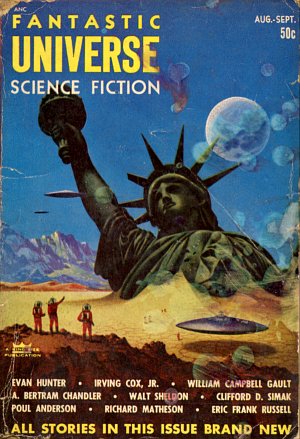
I recently came across this gem of a short story in a collection of science fiction stories on an audiobook compilation and I thought it was worth pointing out. Originally appearing in the August-September 1953 issue of Fantastic Universe Science Fiction, this short story was written by a female author, features a female protagonist and a heroic cat.

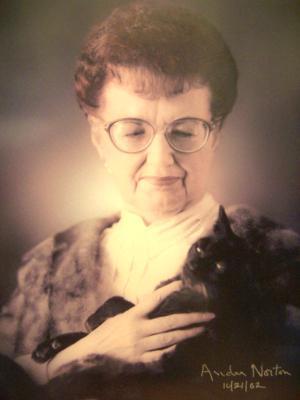
Andre Alice Norton (born Alice Mary Norton) wrote under the pen names Andre Norton, Andrew North, and Allen Weston.  Born in 1912 and dying in 2005, she had a long and successful career as a writer.  This short story was my first exposure to her work. I suggest you visit Andre-Norton.Org for more on the author.

Excerpt: 
This is really the story of Steena, Bat, Cliff Moran and the Empress of Mars, a story which is already a legend of the spaceways. And it’s a damn good story too. I ought to know, having framed the first version of it myself.
For I was there, right in the Rigel Royal, when it all began on the night that Cliff Moran blew in, looking lower than an antman’s belly and twice as nasty. He’d had a spell of luck foul enough to twist a man into a slug-snake and we all knew that there was an attachment out for his ship. Cliff had fought his way up from the back courts of Venaport. Lose his ship and he’d slip back there—to rot. He was at the snarling stage that night when he picked out a table for himself and set out to drink away his troubles.
However, just as the first bottle arrived, so did a visitor. Steena came out of her corner, Bat curled around her shoulders stole-wise, his favorite mode of travel. She crossed over and dropped down without invitation at Cliff’s side. That shook him out of his sulks. Because Steena never chose company when she could be alone. If one of the man-stones on Ganymede had come stumping in, it wouldn’t have made more of us look out of the corners of our eyes.
She stretched out one long-fingered hand and set aside the bottle he had ordered and said only one thing, “It’s about time for the Empress of Mars to appear again.”
As a Star Wars fan it was easy for me to picture this bar as a cantina not so unlike ones we saw on screen or read in the Expanded Universe.  The desperation of down on their luck spacers reminded me of many of those on the fringes of the Star Wars galaxy particularly the smugglers and independent freighter captains we have read about.  The idea of the Empress of Mars, a ghost ship and a way to get rich quick also reminded me of a ship few ships from Star Wars including Another Chance an Alderaanian ship and the Teljkon Vagabond.  Both of these Star Wars ships appeared in Michael P. Kube-McDowell's The Black Fleet Crisis trilogy.

All Cats are Gray is a very short story, the character of Steena is pretty well defined, there isn't a great deal of time for other characters to be developed other than her cat Bat.  What the story lacks in length in makes up for in flavor, it is science fiction but to my ear the dialogue sounded much like an old noir crime story.

It also plays with the concept of disability and how limitations in one area can lead to strengths in another.  The emotional resolution of the story is a bit rushed and could have benefited from being stretched out more.
On the whole Steena is the self-rescuing sort of female leading character who isn't objectified because of her looks that many clamor for even today and her cat and it's peculiar drinking habits was a lot of fun to read about.

I enjoyed this short story a great deal and I hope you give it a shot, it will only take a few minutes of your time.


You can read the complete story for free on The Project Gutenberg website.

Saturday, July 6, 2013

Review: Star Wars: Crucible


“I am incapable of conceiving infinity, and yet I do not accept finity. I want this adventure that is the context of my life to go on without end.”  ― Simone de Beauvoir, La Vieillesse

Everything ends. The modern Star Wars Expanded Universe's novel branch really took off in 1991 with Timothy Zahn's Heir to the Empire.  That novel set at the in-universe date of 9 ABY provided a launching off point for the continued adventures of the heroes of the Star Wars original trilogy of films.  In the 22 years since we have seen novels jump around the in-universe timeline all over the place, yet a main line of novels continued driven by an irresistible moment moved forward on the timeline, with this movement forward in-universe we have rapidly approached a situation where the suspension of disbelief and internal logic of the Expanded Universe's storytelling threatens to collapse upon itself as fans, authors and editors cling to tightly to the continued adventures of the "Big Three" in their elderly years.  

We have seen any number of explanations to keep these aging heroes relevant as action heroes. For example, humans in the Star Wars universe live a lot longer than those in our real world, 70 is more like 50.  We have also heard that Force users remain more vigorous in their old age than mere mortals.

At the same time as we devote precious limited page time to an aging cast of characters we end up sidelining or underveloping younger characters, some of which are in their 30s or 40s now and have yet to really had their time in the spot light. 

In Troy Denning's Crucible, we have reached 45 ABY. In universe almost half century has passed since the destruction of the Death Star.  Luke, Han and Leia still star in the main line of Star Wars novels, passing the spotlight most reluctantly to Ben, Jaina and others.  

Crucible represents the end of a certain era of Star Wars storytelling, yet the looming and likely reboot of the Expanded Universe makes Crucible a bittersweet culmination.  How would the story of Star Wars continue on the page without the big three? What new and exciting characters would be created and fleshed out to carry on the story? 

We have yet to receive any official proclamations from Disney, Lucasfilm, and Del Rey regarding continuity and their intentions with the publishing line after the novels that have already been announced. But Crucible even though it is a stand-alone novel it certainly feels like the a series finale.  Whether this ultimately ends up being the end point of this incarnation of the Expanded Universe remains to be seen.

I hope that rather lengthy preamble puts Crucible in perspective. To me what Denning is tasked with doing in this novel, i.e. retiring Han, Luke and Leia sets a rather lofty bar of expectations.

Crucible Synopsis via Random House:
"Han Solo, Leia Organa Solo, and Luke Skywalker return in an all-new Star Wars adventure, which will challenge them in ways they never expected—and forever alter their understanding of life and the Force.

When Han and Leia Solo arrive at Lando Calrissian’s Outer Rim mining operation to help him thwart a hostile takeover, their aim is just to even up the odds and lay down the law. Then monstrous aliens arrive with a message, and mere threats escalate into violent sabotage with mass fatalities. When the dust settles, what began as corporate warfare becomes a battle with much higher stakes—and far deadlier consequences.

Now Han, Leia, and Luke team up once again in a quest to defeat a dangerous adversary bent on galaxy-wide domination. Only this time, the Empire is not the enemy. It is a  pair of ruthless geniuses with a lethal ally and a lifelong vendetta against Han Solo. And when the murderous duo gets the drop on Han, he finds himself outgunned in the fight of his life. To save him, and the galaxy, Luke and Leia must brave a gauntlet of treachery, terrorism, and the untold power of an enigmatic artifact capable of bending space, time, and even the Force itself into an apocalyptic nightmare."
The novel stars Han, Luke, Leia, and Lando as they attempt to deal with problems surrounding yet another one of Lando's commercial endevours.  

Set in the Chiloon Rift a difficult to navigate and communicate area of space that is rich in mineral resources, and featuring a novel pair of villians (the Columi Qreph brothers) with some interesting henchmen and Mandalorian mercenaries, the set up feels a bit more like the Bantam era than the galaxy in peril plot lines that have dominated the Del Rey era. 

As an Expanded Universe author Troy Denning is not the most prolific, but he has had key novels that have largely defined the the direction of many characters in the EU.  His novel Star by Star is one of the most important to the New Jedi Order series, revealing the fate of Anakin Solo and setting Jacen on his journey that would lead him to the Dark Side. The Dark Nest Trilogy all three books of which were written by Denning takes us six years in universe after the Vong are defeated and presents a Jacen Solo who steps into the spot light with advanced and unusual powers and a deep secret.  Denning next served as the third author in each of the next two nine-book series, Legacy of the Force and Fate of the Jedi, meaning he wrote books 3, 6, and 9.  This means he wrote the concluding book in the last two mega-series.

In both Legacy of the Force: Invincible and Fate of the Jedi: Apocalypse, Denning wrote strong books and in doing so set the paths and fates for many characters that reverberated down the timeline.  Crucible picks up some of the plot threads that Denning laid down in Fate of the Jedi: Apocalypse. In doing so it feels like some of these plots didn't get the time to be explored or too grow that they deserved.  There is one rather odd plot thread that revolves around an injury of Luke's that I am glad didn't get further development. 

There is also a character reveal that could have been left as a mystery to more interesting dramatic effect, but was spoiled so early by the author himself by including to precise a physical description of the characters.  That being said I actually love the characterization for the character. I just believe it would have been more fun for the reader to slowly realize who this character actually as closer to the climax of the novel.

 Denning does some nice work in touching base with some of our recurring characters, Jaina and Jag, Mirta Gev and by reference Boba Fett, and continues the rehabilitation of Tahiri Veila.  

Reading through the New Jedi Order, Tahiri became one of my favorite characters in the Expanded Universe.  Her journey has been pretty crazy but in Crucible, Denning presents mature and for what seems to be the first time in forever a portrayal of Tahiri that isn't psychologically or emotionally damaged.  I also wonder what exactly Ben and Tahiri talk about when they are stuck on a small spacecraft together for a long period of time, I hope it is not that unfortunate interrogation session.

Ben Skywalker also has a relatively minor supporting role in the book but his scenes are very well done and the mixture of humor and intensity that this character possesses makes a character that I would love to read more stories focusing on his adventures. 

The book introduces another Han Solo-lite character in asteroid miner and starship captain Omad Kaeg.  I enjoyed the interactions between Kaeg, Han and Leia and I think that Omad works well because of the generational difference between himself and Han.

I really enjoyed a great deal of the dialogue of this novel, the exchanges between the big three felt pitch perfect and I think Denning really nailed the characterization of both Han and Luke. 

Critics of Denning should be happy, we don't get any Killiks or Barabels. Han Solo and I share a similar dislike of bugs and Insectoid aliens.  Barabels are interesting but extended Barabel dialogue can be grating.  Though it is interesting outside of the Nargons (none of which gets any individual characterization), a Jedi supporting character and the villains, this novel features an almost completely human cast.  

 The thing that struck me about the novel upon first reading was that it has what seems to be an unusual amount of brutality.  While as a reader I didn't think Denning was going to kill any of the big three in this novel, he writes their injuries in such a way that you can almost expect that the next page will have the character dying.  This can either serve to heighten the dramatic tension (if you buy into it) or take you out of the story. I was having Monty Python the Black Knight flashbacks for much of the novel. 


The novel also features cloning of a different variety than we have seen before.  I have to say, this isn't to single out Denning but it strikes me that cloning is becoming an overused plot device in Star Wars fiction.  Yes cloning exists in the universe but it seems like it is in every other book at this point. 

The novel's synopsis describes "an enigmatic artifact capable of bending space, time, and even the Force itself into an apocalyptic nightmare."  It is really at the point that we reach that enigmatic artifact that the novel really waivers for me.  While I enjoy some exploration of the Force and the more metaphysical nature of the Star Wars universe it feels like this novel and some others are going to far.  Just like the Fate of the Jedi series' journey beyond shadows and Pool of Knowledge, it takes Star Wars to a place that feels to be a step to far into the fantastic.

Ultimately the conclusion of Crucible is both satisfying and logical, it feels like it is how things should be resolved.  At the same time in getting there the novel took some detours that I didn't totally enjoy.  Crucible is a worthy and important addition to the Expanded Universe, but I can't help but think if it stayed a little more grounded that it would have delivered a more compelling and fun final (possibly) adventure for our heroes.

For more on Crucible and to read an excerpt visit RandomHouse.com.

Author's note:  A review copy of Crucible was provided by Del Rey/Random House for this review

Monday, June 24, 2013

Book Review: William Shakespeare's Star Wars by Ian Doescher


"Any good piece of material like Shakespeare ought to be open to reinterpretation." ~Denzel Washington 

Let's face it, if you are reading this blog or this review then chances are you have seen Star Wars: Episode IV: A New Hope more than once. In fact chances are that you can either quote back or replay in your mind the entire film.  Perhaps you remember not so fondly your youthful days in school where Shakespeare was a chore and even possibly a bore. Did you need Cliff Notes to struggle through iambic pentameter and rhyming couplets?

Author Ian Doescher combines his love for both Star Wars and Shakespeare into this rather unique retelling of Star Wars.  Sure you may be wary of Shakespeare's prose, but fear not. The beauty of this book is that it can serve as both a novel diversion for fans of Star Wars and also maybe, just maybe it can serve as a young reader's first steps into a larger world, the world of Shakespeare.

I won't pretend to be an expert on Shakespeare, sure I have read his plays and sonnets in school, I have watched various film adaptations of his works and generally I think I understand what he means at least half of the time.  This book is accessible in a way that some of the Bard's work is not because we all speak the language of Star Wars.

The book is a rather quick read and follows very closely the film. Some of the dialogue remains in the book without being signifcantly changed, some lines only have a word or two changed and some are completely reformulated leaving the meaning but fitting this story better. You will note some significant divergences in passages featuring asides and monologues by characters.  Frankly these added elements were my favorite part of the book.  What is R2 really thinking and expressing with all those beeps and boops? Doescher clearly had fun translating Star Wars into the style of Shakespeare and it doth show on the page.

At 176 pages the book contains a handful of black and white illustrations and a lot of white space on the page given it's structure.  This makes the book a very quick read.

I can heartily endorse picking up William Shakespeare's Star Wars this summer. I think you shall enjoy it, perhaps you will even act out a few scenes.

For more on William Shakespeare's Star Wars visit Quirk Books and see this interview with author Ian Doescher.

William Shakespeare's Star Wars goes on sale July 2, 2013 with a MSRP of $14.95.


Editor's Note: A review copy of this book was provided by the publisher Quirk. 

Sunday, June 2, 2013

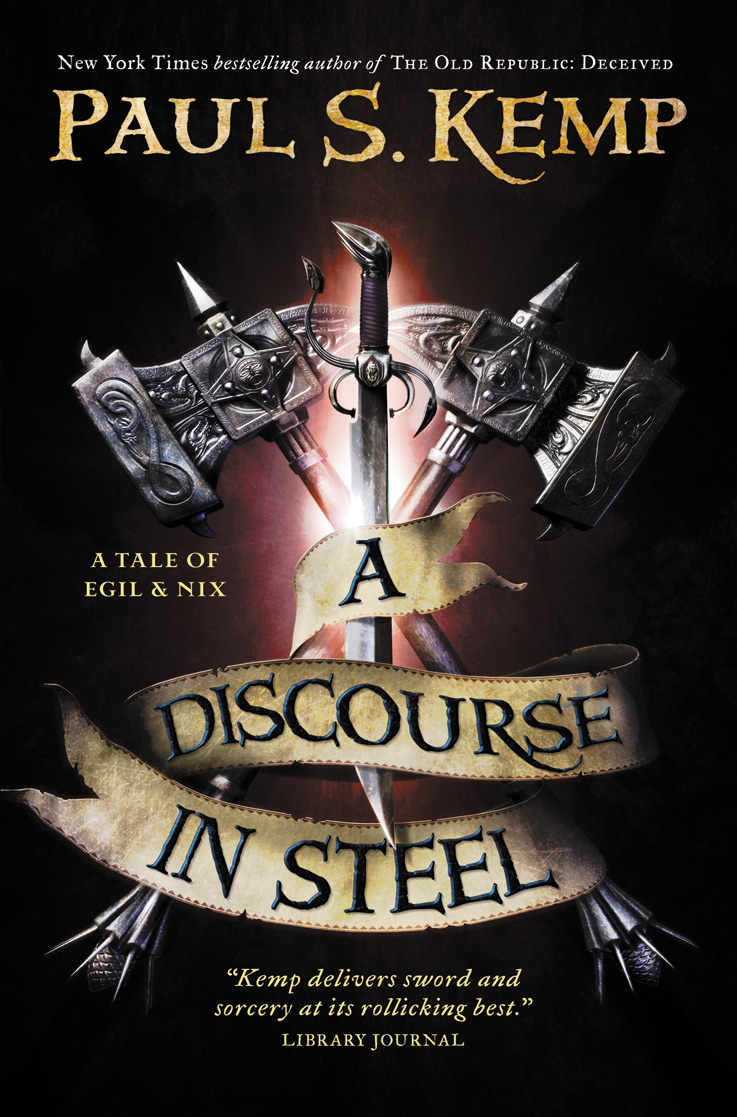
Review: A Discourse in Steel: A Tale of Egil and Nix


Dark and damaged heroes have never been so much fun.  Author Paul S. Kemp appears to be an author at the heights of his powers in his second novel following the adventures of Egil and Nix.  A follow up to 2012's The Hammer and the Blade, A Discourse in Steel is a very different story with different villains and different themes but the same fun.

Publisher's Summary:
Egil and Nix have retired, as they always said they would. No, really – they have! No more sword and hammer-play for them!
But when two recent acquaintances come calling for help, our hapless heroes find themselves up against the might of the entire Thieves Guild.
And when kidnapping the leader of the most powerful guild in the land seems like the best course of action, you know you’re in over your head…
A hugely-enjoyable adventure in classic sword and sorcery mode, from the New York Times bestselling author of Star Wars: Deceived and The Hammer and the Blade.
Egil and Nix aren't looking for a fight, but they are still more than able to bring the violence when it is called for. As a reader you may question their morals based on their owning a bar and brothel, but it's clear that these men have a code.  Protect your own, protect the weak and respect a person's choices.  While Nix does most of the talking and we see most of the novel through his point of view, Egil really stars.  The pain, strength and purpose of Egil drive the novel and we get some great character development that reveals what makes Egil tick and a hint of what he may want for the future.

The antagonists in this novel, the Thieves Guild while evil are a more human evil than we saw in The Hammer and the Blade, this group presents us with the ugly mishmash of organized crime and religious zealotry.  While the Guild provides a multitude of opponents for Egil and Nix, there is a strength in the bond between the two that is much more valuable than a large group of thieves all looking for ways to stab each other in the back.  The conflicts within the Guild provide an interesting side story that drives the plot and shapes the fates of characters in some interesting ways.

One of my favorite aspects of the novel is that both the heroes and the villains of the novel make the same mistake, they bite of more than they can chew.  No matter how much hot water Egil and Nix seem to get themselves into, they always seem to find a way out some times by use of gewgaws and sometimes by blind luck.  Through it all, Kemp delivers dialogue exchanges between the two that runs the spectrum of humorous to touching.  Kemp has the voices of these two characters down and there may be no better example than the third page of chapter seven, (page 148 in the advance review copy) which is possibly my favorite page of fiction in a long while.  Of course as the pair display, sometimes it is best to let your steel do the talking.

The other thing that I really enjoyed about this novel is the continued world building that takes place in Kemp's own fantasy universe.  The mixture of gods, monsters, magic and men provides for familiar character types and settings but with the Kemp's unique brand of violence, salty language and colorful adjectives.

As a reader I do have some issues with the ending of the novel, though I can certainly understand why Kemp chose the direction he did.  But this is only a minor quibble that doesn't detract from the overall enjoyment of the novel.

After reading A Discourse in Steel, I only have one question...when does the next tale of Egil and Nix come out? I suggest you grab a good ale and sit down with this book, I don't think you will regret it.

LINKS: Angry Robot Books, PaulsKemp.com, Amazon.com and Goodreads

Wednesday, May 1, 2013

Star Wars: Dawn to the Jedi: Into the Void Review


Acclaimed author Tim Lebbon makes his first foray into the Expanded Universe in Star Wars: Dawn of the Jedi: Into the Void. This hardcover novel features an interesting mix of world building juxtaposed with an intimate character study centered on Lanoree Brock and those who flow in and out of her life.

Publisher's Summary:

On the planet Tython, the ancient Je’daii order was founded. And at the feet of its wise Masters, Lanoree Brock learned the mysteries and methods of the Force—and found her calling as one of its most powerful disciples. But as strongly as the Force flowed within Lanoree and her parents, it remained absent in her brother, who grew to despise and shun the Je’daii, and whose training in its ancient ways ended in tragedy.

Now, from her solitary life as a Ranger keeping order across the galaxy, Lanoree has been summoned by the Je’daii Council on a matter of utmost urgency. The leader of a fanatical cult, obsessed with traveling beyond the reaches of known space, is bent on opening a cosmic gateway using dreaded dark matter as the key—risking a cataclysmic reaction that will consume the entire star system. But more shocking to Lanoree than even the prospect of total galactic annihilation, is the decision of her Je’daii Masters to task her with the mission of preventing it. Until a staggering revelation makes clear why she was chosen: The brilliant, dangerous madman she must track down and stop at any cost is the brother whose death she has long grieved—and whose life she must now fear. 
Includes a special, full-color excerpt from the Dark Horse comic Star Wars: Dawn of the Jedi and an original Dawn of the Jedi short story by John Ostrander!

Lebbon gets the privilege in playing in a relatively open field of storytelling. While there is the Dawn of the Jedi comic series produced by Dark Horse Comics, there is not a lot of continuity or established stories and characters to limit storytelling.

In terms of the physical book itself, this hardcover is not the first time that Del Rey had included a comic book excerpt within a novel, however the inclusion of the comic panels in a hardcover works much better and is much more enjoyable than in a paperback or trade sized novel.  Into the Void also contains the prequel short story Dawn of the Jedi: Eruption by John Ostrander and an excerpt from Troy Denning's forthcoming Star Wars: Crucible.

While the Je'daii focus on the Force and on balance, it is the ability to dabble in both the light and the dark that make the Je'daii distinct from the latter-day Jedi. The Je'daii society we meet in Into the Void in some ways seems very similar to the Jedi we are familiar with, on the other hand they seem poised on a knife edge, at anymoment you get the feeling that they could slip into a cold brutality that is very un-Jedi like. The Je'daii journey and Temple system is a very cool way to test and instruct potential Je'daii.

One major difference that Star Wars fans will notice is that there are no lightsabers.  The Je'daii used forged blades.  Lanoree does some serious damage with her sword.  At times Lebbon describes the action scenes in detail that may be a tad graphic for younger readers, but there isn't anything disturbing enough to be hesitant giving this book to kids.

The nature of Tython and who the population was assembled there leads to a diverse and interesting mix of species in the novel.  I can honestly say I really wasn't expecting Noghri to appear in this novel, particularly given it's setting in the ancient past of the Star Wars universe.

Into the Void also introduces some new and different uses of the Force, particularly Lanoree's particular talent of alchamey of the flesh, which feels very similar to what the later Sith would do.

This duality among the Je'daii is reflected in the novel's main character, Lanoree Brock. Lanoree is a fascinating character in that you become comfortable with her internal conflict and her emotions which for most of the novel are tied up in duty and family. Her focus is largely on her brother. But to Tre Sana and others it seems like the emotion that she has for her family is largely absent, the casualness with which she dispatches or contemplates dispatching others in the novel is jarring at times.

The plot of the novel is fairly simple, Lanoree is recalled to Tython to be given a special mission by the Je'daii  Masters.  She has been chosen to track down and stop a cult that is dabbling in dangerous ancient technology that could either lead to reconnecting with the larger galaxy outside the deep core or lead to the destruction of everyone on Tython and the surround system.  Lanoree is chosen because the leader of this group is none other than her brother who was assumed to be dead.  The sister hunting brother story may feel a little familiar to those who have read the Legacy of the Force series which featured towards the end Jaina training to then hunting down her brother Jacen.

The story leaves some interesting plot threads open for future storytelling whether it be in prose or in the comic series.  I am fascinated to learn more about the Je'daii who often seem amoral.  Lanoree is a character that even after reading the entire novel I am not sure if I fully understand her.  This uncomfortableness with the character is good in that it prevents predictability from setting in.

Lebbon uses the literary techniques of epigraphs and flashbacks liberally throughout the novel. The epigraphs focus on quotes from Je'daii which provide some background on the Je'daii philosophy.  The first time I really paid attention to this particular literary device was when reading Karen Traviss' novels.  I really like them because they allow the author to set up or frame the content that is to follow.  It allows you to give the reader information that it could be clumsy to include in the body of a chapter or in dialogue.  The other feature is that as a historian this allows you to introduce primary sources or documents in the Expanded Universe by referencing passages from these works. The creation of Expanded Universe primary sources is another level of geekiness that I particularly enjoy.

The flashbacks focus on Lanoree and Dalien in their youth as they begin and end their Je'daii journey, traveling across Tython to the various Je'daii temple. Dalien is a flawed character, but how much of his faults are evil and how much are the rebelliousness of youth?  Dalien's relationship to the Force is one of the more interesting questions throughout the novel.

When you are introducing new characters and a new setting such as with the Dawn of the Jedi it makes sense to use a limited cast of characters, this allows the reader to adjust to the setting without getting to confused with keeping track of who is who and how they relate. Tre Sana and Kara are probably the most memorable of the relatively small cast of supporting characters. Tre is interesting because of what was done to him and what little we learn of his past.  While Kara is interesting because of the imagery that the description of her character provides and her equally shrouded past.

In the end author Tim Lebbon delivered a novel that is all about the relationship between a brother and a sister, all good stories focus on relationships and this one is no different.  Oh and did I mention the beheadings?  It's got that too.

Editor's Note:  A review copy of the novel was provided by the publisher. 

Thursday, January 10, 2013

Review: Star Wars: Scoundrels by Timothy Zahn


Perhaps this makes me a bad fan or more likely a bad reviewer, but every time a new Star Wars book is announced and released my expectations for that novel usually far outstrip what it is reasonable to expect.  As such I generally try to read the novel twice before reviewing it.  Reading Scoundrels the first time it took me a surprising long amount of time to get through, and upon a second reading while my opinion of the novel improved, it was not a significant improvement.

As much as I admire and appreciate Timothy Zahn's contributions and hopefully future contributions to the Star Wars universe, Scoundrels is a book that is mildly enjoyable but decidedly average.

The premise is fairly simple, we have Han and Chewie recruited to steal some stolen credit tabs (identity coded payment devices) and in order to do so they must recruit a crew from amongst the galactic fringe who have skills and abilities that our dynamic duo lacks.  In accomplishing their mission they are forced to trust and rely on individuals they either do not know well or have reasons to question their loyalty. The plot is complicated by the fact that the heist involves stealing from Avrak Villachor, a Black Sun sector chief. Conveniently Villachor is hosting an elaborate festival on his lavish estate that allows for Solo to scheme and plot.  Things get even crazier when you add in the presence of Qazadi a Faleen Black Sun Vigo and Dayja and D'Ashewl a pair of Imperial Intelligence agents.

The book had some interesting treats for Lucasfilm fans as well as Expanded Universe fans. The "Han Shot First" scene as well as the Raiders of the Lost Ark scene were fun if a bit cheesy. The inclusion of some minor characters like Winter and Kell Tainer is also a nice treat for long time EU readers.

There are two strengths that generally flow through all of Timothy Zahn's Star Wars works.  He is able to weave multiple plot lines which stand up well on their own together at the climax of his stories.  Everyone ending up at the same spot in the final battle provides satisfying resolution to the story, but does require some suspension of disbelief.

The other strength that Zahn usually exhibits is creating strong, memorable and fun characters.

Scoundrels feels like a disappointment to me because in these two key areas it feels like one of Zahn's weaker novels.

On the plot, we have the main plot of the story which involves Han's planning and running the heist, we have the "B" plot involving Villachor's attempts at self-preservation and machinations within Black Sun, and the "C" plot focusing on Dayja and the Imperial's interest in taking down Black Sun.

Not all Star Wars novels fit into the traditional formula and involve lots of action, warfare, dueling, etc. In this novel while their was action in parts it was more of a suspense feel than the space opera we usually get.

I can't help but feeling that if their was a more aggressive and action packed subplot it would have helped support the main plots better.  Of course different readers have different preferences, so my opinion may not be reflective of the fan community at large.

Plot can be overcome however if there are great characters. In Scoundrels it feels like Han's characterization was slightly off, Chewie was underused and the majority of the new characters were underdeveloped and bland.

Han didn't feel right in this novel and at times comes off as borderline omniscient.  While we know Han is a wily and clever operator, it seems like he was just slightly too clever in this novel.  There was also one particular scene where post-Episode IV but pre-Episode V Han should have flirted but instead reacted negatively to Bink's teasing flirtation.

One of the fun things about a novel set in this era is the ability to play Chewie and Han off of each other and use a character that is not available in the later EU.  The problem in this book is that because of the inclusion of so many characters, Chewie is largely marginalized.

Realistically of the new characters the only ones that I felt a strong interest in were Bink, Villachor, and to a lesser extent Security Chief Lapis Sheqoa.

Qazadi, Dayja and the Solo's crew were introduced but largely underdeveloped characters. They were there, but there wasn't a lot to make me care for or hate them.  In particular both Qazadi and Dayja feel like simple plot devices to apply pressure to Villachor from different directions.  Dayja in particular got a fair bit of page time for a character that feels like a random generic Imperial Intelligence agent.

Bink is an interesting and fun character and I hope we see her in other stories down the road. Villachor who's life is hanging in the balance for the majority of the novel is a compelling character, and Sheqoa who's relationship with Bink and Villachor makes him a pivotal minor player in the story provides an interesting "good guy who is working for a villain" character.

Just like at the Sabacc table, you win some and you lose some. Unfortunately this novel doesn't feel like a winning hand.

Scoundrels is on sale now in hardcover, ebook and audiobook formats.

Author's Note: An advanced review copy was provided by Random House for this review.


Wednesday, November 7, 2012

Review: Star Wars: The Old Republic Annihilation


Drew Karpyshyn is back and this time his novel doesn't focus on Darth Bane or the Jedi formerly known as Darth Revan. In Annihilation, Republic spy Theron Shan takes center stage in an action packed, clothing optional adventure. 

Star Wars: The Old Republic: Annihilation is the fourth in the "The Old Republic" series of novels, following Fatal Alliance, Deceived, and Revan. These novels are written as tie-ins to BioWare's MMORPG video game, "Star Wars: The Old Republic."

Chronologically Annihilation is the fourth book in the series .  Using the BBY (Before Battle of Yavin) dating system, Revan is the earliest book set between 3,954-3,900 BBY, Deceived is next at 3,653 BBY, then Fatal Alliance at 3,643 BBY and finally Annihilation at 3,640 BBY.

Each novel in the series is written as a stand-alone, so it is easy to read them without having to know information from the others. There are however references to characters and events that you will need to know the earlier books to fully understand. If you read Annihilation and then want to know about the Sith Emperor then check out Revan, want to read about Darth Malgus then read Deceived, want to learn more about Satele Shan then check out Fatal Alliance. It is also worth noting that Star Wars Insider magazine will have a related short story in issue #137 released in late October, that story by Alexander Freed is entitled, "The Last Battle of Colonel Jace Malcom."

The Publisher's synopsis of Annihilation gives a nice encapsulation of the story:

"The Sith Empire is in flux. The Emperor is missing, presumed dead, and an ambitious Sith lord’s attempt to seize the throne has ended fatally. Still, Darth Karrid, commander of the fearsome Imperial battle cruiser Ascendant Spear, continues her relentless efforts to achieve total Sith domination of the galaxy.  
But Karrid’s ruthless determination is more than matched in the steely resolve of Theron Shan, whose unfinished business with the Empire could change the course of the war for good. Though the son of a Jedi master, Theron does not wield the Force—but like his renowned mother, the spirit of rebellion is in his blood. As a top covert agent for the Republic, he struck a crucial blow against the Empire by exposing and destroying a Sith superweapon arsenal—which makes him the ideal operative for a daring and dangerous mission to end Ascendant Spear’s reign of terror.

Joined by hot-headed smuggler Teff’ith, with whom he has an inexplicable bond, and wise Jedi warrior Gnost-Dural, Darth Karrid’s former master, Theron must match wits and weapons with a battle-tested crew of the most cold-blooded dark side disciples. But time is brutally short. And if they don’t seize their one chance to succeed, they will surely have countless opportunities to die."

The main character of the story is Theron Shan, the son of Jedi Grand Master Satele Shan and agent for the Republic's spy agency Strategic Information Service (SIS). Theron also starred in the Dark Horse Comic story arc, Star Wars: The Old Republic: Lost Suns. History buffs will notice the SIS name is very similar to the United States' Office of Strategic Services that was formed in 1942 during WWII.  The OSS was the predecessor to the CIA. In thematically Annihilation is the sort of spy story that could fit in a WWII or Cold War setting.  I particularly liked this setting of the story it was a nice change of pace and gave an interesting flavor to the characters in the story.

What would happen if you combined James Bond, Sterling Archer and Lobot? You would probably get someone like Theron Shan. Shan is a reckless yet effective secret agent with a unique set of cybernetic implants on his head and some fashionable but deadly bracers (wrist mounted weapon platforms) on his arms.

Shan, the SIS, the Republic military and the Jedi are all on a mission to find and destroy the superweapon ship the Ascendant Spear and it's former Jedi turned Sith commander Darth Karrid. I like superweapon stories, they hearken back to the Bantam era novels and the early Expanded Universe. They are also evocative of the Original Trilogy of Star Wars films and it is easy to think of the Ascendant Spear like the Super Star Destroyer of it's day.

A number of characters from previous TOR novels, the video game and associated contact are included or mentioned in this novel.  We also get a bit of a bombshell about what happened to Darth Malgus after Deceived.  It is fitting that Karpyshyn wrote this novel because it allows him to play with some TOR era Sith world building, using ideas that he introduced in terms of Sith society in that novel to flesh out this story.

In the lead up to the release of the video game, Star Wars: The Old Republic, www.SWTOR.com released a series of in-universe videos narrated by actor Lance Henriksen as Kel Dor Jedi Master Gnost-Dural.  These videos are very cool and give you back ground on the TOR era. Dural plays an important role in the novel so it is cool to see them fit him into continuity in this way.


In addition to Theron and Gnost-Dural, we get an interesting mix of other species and characters from Sith, Hutts, Smugglers and Imperial Bureaucrats. My favorite character in addition to Theron is Republic Supreme  Commander Jace Malcom.  I won't go into details to avoid spoiling the story but Malcom is a man's man and  provides emotional weight to the story.

As the story develops it revolves around choices that the central characters make and made, choices between family and duty. The burdens our characters put upon themselves weigh heavily whether it is loyalty or leadership, we have a group of heroes here that are flawed but noble.

Annihilation is a tightly crafted story that moves quickly and presents new and interesting characters.  I highly recommend this novel to any Expanded Universe fan.

Star Wars: The Old Republic: Annihilation goes on sale Tuesday, November 13th in hardcover, ebook and unabridged audio book formats. For more information on Annihilation visit RandomHouse.com

One last thing before you read Annihilation, take a second and watch again the Star Wars: The Old Republic "Hope" Trailer. You will thank me later.


Author's Note: A copy of Annihiliation was provided by the publisher for this review. 

Sunday, September 30, 2012

Review: Star Wars: The Essential Reader's Companion by Pablo Hidalgo


I like to think Pablo Hidalgo wrote this book  just for me.  My favorite area of Star Wars fandom is the novels, I love reading the books set in the galaxy far, far away.  The benefit of this is that my mental special effects budget is unlimited. The downside is that at this point there are so many novels and short stories that it can be easy to forget what happened where and keep the hordes of supporting characters straight.

I have been forward to this book for a number of reasons. The handy ability to quickly check out a books summary to remember what it was about when I am contemplating a re-read. The ability to catch up on the more obscure short stories or tales that I may have missed along the way.  The hopefully entertaining and insightful editorial comments inserted by Mr. Hidalgo. Then once we started seeing rough artwork from the book I also became very excited to get my hands on this reference book for the artistic eye candy.

What did we end up getting?

The Essential Reader's Companion is a bookshelf busting 496 page, 2.8 pound tome. It is structured chronologically with an Introduction, two appendices and eight chapters. While it is a massive book in page count it is smartly designed in terms of height as to be very readable and not become difficult to handle while reading.  The book comes with a MSRP of $29.95 but you can find it on sale for much lower than that.

The Introduction:

In the introduction Pablo lays out the scope and mission of the book. He discusses what is and what is not in the book and the reason behind those decisions. He also touches upon a suggested reading order and the issue of canon and continuity.

This is important to set the reader's expectation. What you get here is an exploration of the Star Wars prose fiction universe.  While Pablo touches upon comic books, the Clone Wars series or video games where it is relevant those topics are only brought up in relation and how they interact in a specific way with the prose fiction. Without this limitation the project of writing this book would not doubt have been impossible.

The Chapters:

The body of the Companion is broken down into eight chapters.

  • Chapter 1: Tales of Ancient Jedi and Sith
  • Chapter 2: Height of the Republic
  • Chapter 3: The Clone Wars
  • Chapter 4: The Dark Times
  • Chapter 5: The Galactic Civil War
  • Chapter 6: The New Republic
  • Chapter 7: The New Jedi Order
  • Chapter 8: Legacy

It should be noted that as of it's publishing the Companion includes five yet to be published works of fiction.

"The Last Battle of Colonel Jace Malcom" from Insider 137(Pub. Date 10/24/12), The Old Republic: Annihilation (Pub. Date 11/13/12), "Heist" from Insider 138(Pub. Date 12/12/12), Scoundrels (Pub. Date 12/26/12), and The Clone Wars: Darth Maul: Shadow Conspiracy (Pub. Date 1/1/13).

If you want to avoid spoilers from those stories you should skip the sections that talk about those pieces.

Each entry in the Companion features the following information when applicable:


  • Author
  • Cover Artist
  • Publication History (Format and Date)
  • Time Line Placement (In universe BBY/ABY calendar)
  • World Visited (Atlas coordinates included)
  • Main Characters (In dramatis personae style of name, role, species and gender)
  • Summary

Hidalgo's editorial comments generally appear after the summary when they relate to that book or in a separate box if it relates to a larger issue or series of stories.  These comments range from trying to untangle continuity messes to cool behind the scene tidbits about what almost happened with certain stories. In terms of the text of the book, I just wish we had more room for these pearls of wisdom from behind the scenes, but there are only so many pages and some secrets have to remain secret.

One addition that I would have liked to see more explicitly spelled out in the bullet points for each work is a list of books or stories that heavily referenced that work.  This way make it easier for the reader to follow story or character through-lines which may not be contained in a specific series.  I believe Hidalgo does this to an extent in the book, but I would have liked a more definitive and spelled out list of connecting works.

On top of the entries we also get a variety of artwork in the book. We get the story source's cover art, we get full and half page illustrations and we get character portrait galleries.

Jeff Carlisle, Joe Corroney, Chris Scalf, Darren Tan and Chris Trevas provide the illustrations throughout the book, while Brian Rood handles the character portrait galleries.

The art takes the Companion to another level.  It is very well done and there is a pretty good variation in styles. I think the variation in styles is smart, as I tend to prefer the works of Tan and Trevas over those of Carlisle, but I think some fans may feel the opposite.  It doesn't put all of your eggs in one artistic basket.

In any book particularly one this large there are no doubt editorial decisions that are made with great difficulty.  My one major criticism of the book is that the character portraits by Brian Rood are done so well that it is a shame that the portraits are only about 1.75" x 2.25" and arranged six to a page.

The book is printed on very nice slightly glossy paper that really makes the artwork pop.  There is a nice mixture of major character and minor characters and some truly strange and unique choices of subject matter scattered through the book.

The Appendices: 

The Companion contains to appendix, Appendix A: Works in Publication Order and Appendix B: Works by Author.

These two resources also include the page number in the Companion where that work appears. Say did you like an Aaron Allston novel you read and want to find out what other Star Wars books he has written, you can go the Appendix B and then shoot to the page offering the description of the books.

Say you are relatively new to the EU and come across something that strikes you as odd or out of place in the EU. Check Appendix A and when the work was published may help explain why something doesn't seem to fit. Or say like me you took a few years away from the EU, then if you go to the appendix you can look and see what was published in the years you missed and seek out those items.

Conclusions:

 This long awaited book by author Pablo Hidalgo and his rogue squadron of talented artists satiated this bibliophile's Star Wars book addiction. If you are a veteran of the EU pick up this book and let it remind you of some books or stories you may have forgotten and reconnect with those old friends. If you are new to the EU pick up this book and perhaps it will help you navigated the twisted hyperspace lanes that make up Star Wars publishing.

The Essential Reader's Companion will turn out to be both essential to my collection and a true companion that I turn to often.

The Essential Reader's Companion goes on sale October 2, 2012 in trade paperback (MSRP $29.95) and e-book (MSRP $12.99) formats.


Note: Review copy of The Essential Reader's Companion provided by Random House.


Thursday, August 16, 2012

Review: DK's Star Wars: The Ultimate Visual Guide: Updated and Expanded by Ryder Windham


On April 30, 2012 Lucas Books and DK released an revised edition of their book Star Wars: The Ultimate Visual Guide.  The new addition received a new subtitled "Updated and Expanded" as well as about 40 pages of new material. The book weighs in at 200 pages and is 9.88 inches wide by 11.88 inches tall.  

I do not have the previous edition of the book so this review will focus on the new edition including comments on both the new and old material.

Revised and expanded! 
Star Wars: The Ultimate Visual Guide, newly revised and expanded, reveals the story of the amazing Star Wars saga in full detail. 40 new pages help to explain every detail about Star Wars from the millennia- spanning history of George Lucas's long ago, far away galaxy to the Star Wars movies and ever-expanding range of books, novels, comics, and media. Packed full of interesting facts about the world of Star Wars merchandise and fandom, astonishing pieces of art, and full-color photographs, DK's compendium is the key to knowing ALL there is to know about the iconic brand that is Star Wars! 
Featuring tons of all-new content including characters, storylines, vehicles, weapons, merchandise, news, and beyond: 
LEGO® Star Wars™ sets and minifigures
Latest seasons of the ever-popular animated series, The Clone Wars
The Force Unleashed video games
Blue-ray release of Episode I: The Phantom Menace
Updated galactic timeline and galaxy map
And much, much more! 
© 2012 Lucasfilm Ltd. ® & TM All Rights Reserved. Used Under Authorization.
The book can roughly be divided into two major sections, the first is an in universe chronologically based visual tour through the Expanded Universe, TV shows and films. The second section is "Behind the Scenes" and features information on the creation of the universe, merchandising and fandom.  

Written by Ryder Windham, the book also features a forward by actress Ashley Eckstein.  This is a large coffee table style book and features a dust jacket with cover art that is also reproduced on the cover of the book itself.  This aesthetic feature is nice in case you are less than gentle and your dust jackets end up looking like mine.  

Generally the book is laid out in two page sections each focused on one common theme.  For example the 2 page spread on The Old Republic video game is entitled, "The Great Galactic War." Later on in the time like we get a section set during the Dark Times entitled, "Life on Tatooine." This two-page at a time format is wonderful in that it makes the book one that is easy to pick up and put down at your leisure without having to re-read a large chunk of material.  

There is so much material in the Star Wars universe that fans become compartmentalized at times, for me this means that I cannot consume everything.  My fandom consumption focuses on the adult novels and the television and film products.  This leaves a rather large gap in my fandom, i.e. the comics.  While I have read some of the comics, mostly in graphic novel form, I have missed a lot of Star War stories.  One of my favorite features in this book is the inclusion of comic panels throughout.  I just love seeing the various comic images from different periods in the Star Wars comics, different art styles and different takes on the same characters.  

In addition to comic panels we also get other artwork, concept artwork, screen captures and photographs that combine to create a visual smorgasbord as diverse as the Mos Eisley Cantina's cast of creatures. 

Other highlights of the book for me are the timeline and trade route map at the beginning of the book, the Index at the back of the book, and the Clone Wars section which helps clear up some of the chronological issues in terms of which episode goes where in the timeline.  

The timeline is a nice broad overview that allows fans to conceptualize galactic history, this outline is fleshed out throughout the book as the top of the pages are labeled with an era name and an in universe date range.  

I love the trade routes map, its small enough to let you see the big picture but large enough to see detail.  It also is a nice tease for people. If you like this map go pick up the Essential Atlas

Maybe it is my days and nights researching in college that taught me to love an index, but I wish every book came with one.  When you are immersed in the Expanded Universe there are times when things start to blur together, the ability to quickly find the information you are looking for is a nice tough.  

While it may not be the final order of the Clone Wars chronology this books lays out the episodes in a rough order that can be helpful to fans that really enjoy having a clear historical timeline.

Possibly the most surprising part of the book is the meatiness of the text.  With so many images on the pages and the "Visual Guide" title one would expect some skimping on the written material.  I am pleased to report that author Ryder Windham packs lots of information and text onto the pages and that makes this book a surprisingly long read.  

Star Wars: The Ultimate Visual Guide: Updated and Expanded is a substantial book that draws on a diverse set of images and solid written material to take you on a time machine through the history of the Star Wars universe and beyond. 

MSRP is  $24.99 and the book is on sale now. 

Author's note: Review copy provided by DK Books.


Wednesday, August 1, 2012

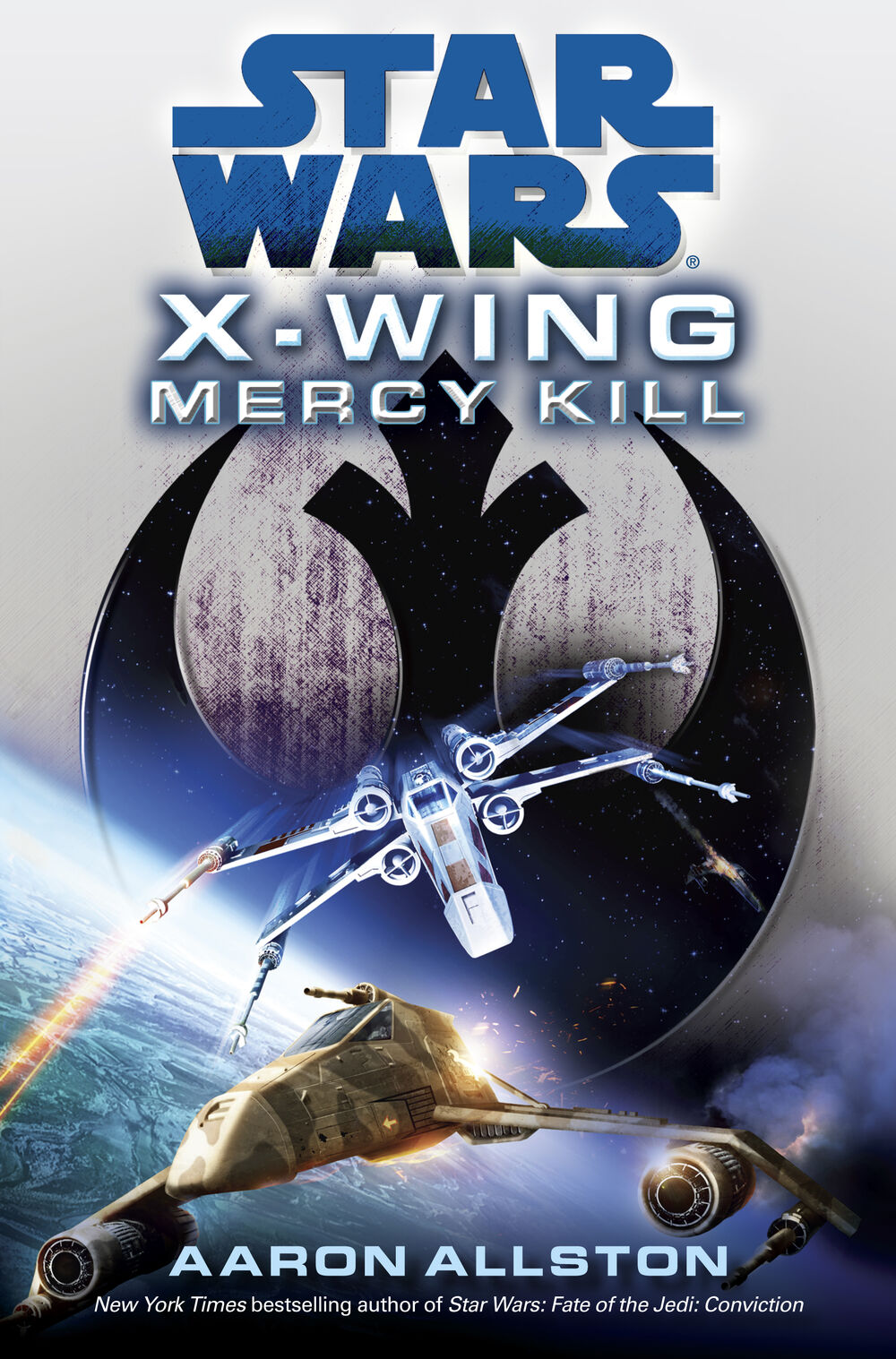
Review: X-Wing: Mercy Kill


Author's Note: The following review contains mentions of some characters appearing in the novel, so it may be a very minor spoiler for those who haven't yet seen the Dramatis Personae.

Leave it to Aaron Allston to get the band back together, no not the Cantina Band, but the WRAITHS.  In the early days of the New Republic Rogue Squadron Commander Wedge Antilles saw the need for a new breed of special forces, individuals that possessed diverse commando skills and secondarily where capable Starfighter pilots.  Of course Wedge ended up choosing a motley crew of individuals that went on to be featured in Allston's 5th, 6th and 7th novels in the X-Wing series, Wraith Squadron, Iron Fist and Solo Command

If you have yet to read the X-Wing series, I cannot recommend enough reading that series before you read Mercy Kill.  It would also be beneficial to read the Fate of the Jedi series, as the plot revolves around one of the subplots withing that series.  Mercy Kill is in and of itself a fully self contained story.  Through the use of flash-backs and exposition to provide important back ground and context for the characters involved.  What Allston does that is important to good storytelling is strike the balance between catering to new audiences and returning audiences, you have to assume fans will have read the other books but you can have some touchstones in the story to jog their memory.

Mercy Kill is a return to a cast of characters many years since we have last seen them except in brief moments.  Most people will recognize the obvious skill with which Allston wields humor, especially when writing the Wraiths.  In the original Wraith novels, comedic reprobate Wes Janson was the frequent purveyor of humor.  
Voort

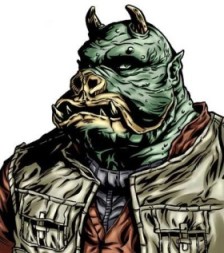
Less well recognized than Allston's comedic chops are his ability to convey emotion and create scenes and situations that force the reader to experience his novels in a very visceral way.  In Mercy Kill, Allston takes one of the more interesting characters created in the Expanded Universe, Voort "Piggy" saBinring, a super-intelligent Gamorrean who was surgically altered not only to be vastly more intelligent than the rest of his species but was also given the ability to talk. 

There is a bit of  Frankenstein's monster in the make up of Piggy, both Piggy and the monster where created in a laboratory, they did not choose their state of being.  Both Piggy and the monster experience extreme social isolation based on their natures.  I am fascinated by the idea that while we consider intelligence a gift, there is a certain bliss in ignorance.  If Piggy was never altered, he could have perhaps led a perfectly happy Gamorrean life with a rubenesque wife and three little piglet off-spring?  It is Piggy's intelligence that both creates this social barrier with the rest of his species and makes him aware of his isolation.

Piggy's story may also ring true with military veterans or people who have known military veterans.  The generation of characters that Piggy is from where born into and lived in constant conflict against the Empire and its remnants.  Piggy found not only his purpose but also what he was good at in Wraith Squadron.  How does one adjust to life outside of that military structure?  How does one handle the emotions of what one had to do during war time when the surge of adrenaline high emotions of combat wane?  How does one adjust to a world that has moved on, when you are still reliving an event or series of events?

I could go on and on about how much I love the choice of Piggy as the emotional backbone of this novel, but I would rather talk about it after you read it.  We need more off-beat leading characters the SWEU, apologies to random human male Jedi A and random human female Jedi B.

Taking place primarily in 44 ABY  it is hardly surprising that we find the Wraiths in various different places in their lives.  Allston provides a nice mixture of returning characters (Wedge, Face, Piggy, Bhindi) and new characters (Trey, Truman, Scut) or semi-new characters (Jesmin and Myri) who are getting their first chance in the spotlight. Taking a step back from Mercy Kill for a minute, the ability to push pre-existing secondary characters into the forefront or to introduce new compelling characters is essential for the long term health of the Star Wars Expanded Universe.  There are only so many times when the big three (Han, Luke, Leia) can save the galaxy as septuagenarians and as the next generation approaches middle age, it almost feels at times that the SWEU has missed the hand off of the lightsaber between generations.  With Ben Skywalker and Alana taking center stage it is really the third generation of the SWEU characters that are coming to the forefront of story telling.  

Without going to deep into the story and spoil elements, jokes or the overall readers enjoyment, I just wanted to highlight two other characters that appear in the novel that I particularly enjoyed.

Myri Antilles will make fans smile.  The daughter of a fighter jock and an spy would seem like the perfect candidate to add to Wraith Squadron, the fact that she also picked up some less then savory skills and contacts amidst the gamblers dens aboard the Errant Venture is just the cherry on top of her characterization.   Myri has some great lines in this book, and if this reader had his druthers she would be a key player in future Star Wars novels.  More Myri please.
Vua Rapuung

The other character that I really enjoyed was Scut.  I don't think it is giving too much away to say that Scut is a member of the Yuuzhan Vong species.  With the exception of the Legacy comic series there has been a rather noticeable absence of the Vong from post New Jedi Order novels.  We will get references to them, we will see the results of the invasion, but the characters and the species themselves seem to be gone and forgotten along with Zonama Sekot.  Scut's very presence provides emotional tension and lets Allston play with some very real world realities in this story.

While the Bantam era of Star Wars story telling often felt like Super-weapon of the week story telling, the Del Rey era has come to feel often like one grand galactic conflict after another.  The beauty of Mercy Kill is that it's plot revolves around a rather minor sub-plot from the Fate of the Jedi series.  In the grand scheme of galactic history, the plot of Wraith Squadron would be but a small blip, but in telling this minor story the characters are allowed to shine.  Allston succeeds in recognizing what to many writers fail to comprehend, it is not the scale of the conflict that creates drama, it is the conflict within and amongst the characters that creates the drama.

After reading Mercy Kill, the best compliment that I can pay is that I adore this novel, and if you are a fan of the Wraiths I think you will as well. 

Wednesday, July 25, 2012

Review: Beware the Sith by DK Publishing


Beware the Sith or if you are a Jedi of questionable moral fiber perhaps it is better to be aware of the Sith. In any event the publisher DK in February of 2012 release a book on the Dark Side targeted at children between the ages of 7-12.

Beware of the Sith features tons of images from the six Star Wars movies with little snippets of knowledge about the Sith, focusing on Palpatine and his various apprentices. Presented in this 96 page hardcover book is a collection of sections that are set up roughly like magazine articles with lots of images and word bubbles spread across them. As an introduction to some information about the Sith beyond the film, I think it does a great job dropping small EU nuggets like the Sith Code, Darth Bane and Darth Plagueis.

While as an adult reader some of the information presented is over simplified and some of the sections like "Sith Plan: Take Control" could have been worded differently, overall it is a cool way to get your Youngling reading, particularly if they have slightly evil inclinations.

My two favorite sections where the floor plan and description of Palpatine's offices and the section on Sith Artifacts. Any time we get to see high quality images of props that we see briefly or only in passing in the films I enjoy that.

The section of the book entitled "Becoming a Sith" has an awesome set of four photos of actor Ian McDiarmid as Senator Palpatine, then Supreme Chancellor, then Prequel Darth Sidious and finally original trilogy Emperor Palpatine. This is an awesome visualization of the transformation that the character went through. The only problem is that it seems to imply that the use of Sith Lightning caused the transformation, not the fact that Mace Windu used his lightsaber to redirect the lighting to Sidious that caused the disfigurement.

While as a critical adult Expanded Universe reader I have some issues with some of the content of the book, I absolutely loved the visuals in it and was surprised by the amount of detail and information that was provided at times. I think if your kids are anything like I was when I was younger, they will love this book. The bad guys are always have cooler stuff.

For more on Star Wars: Beware the Sith visit DK.com

Wednesday, July 18, 2012

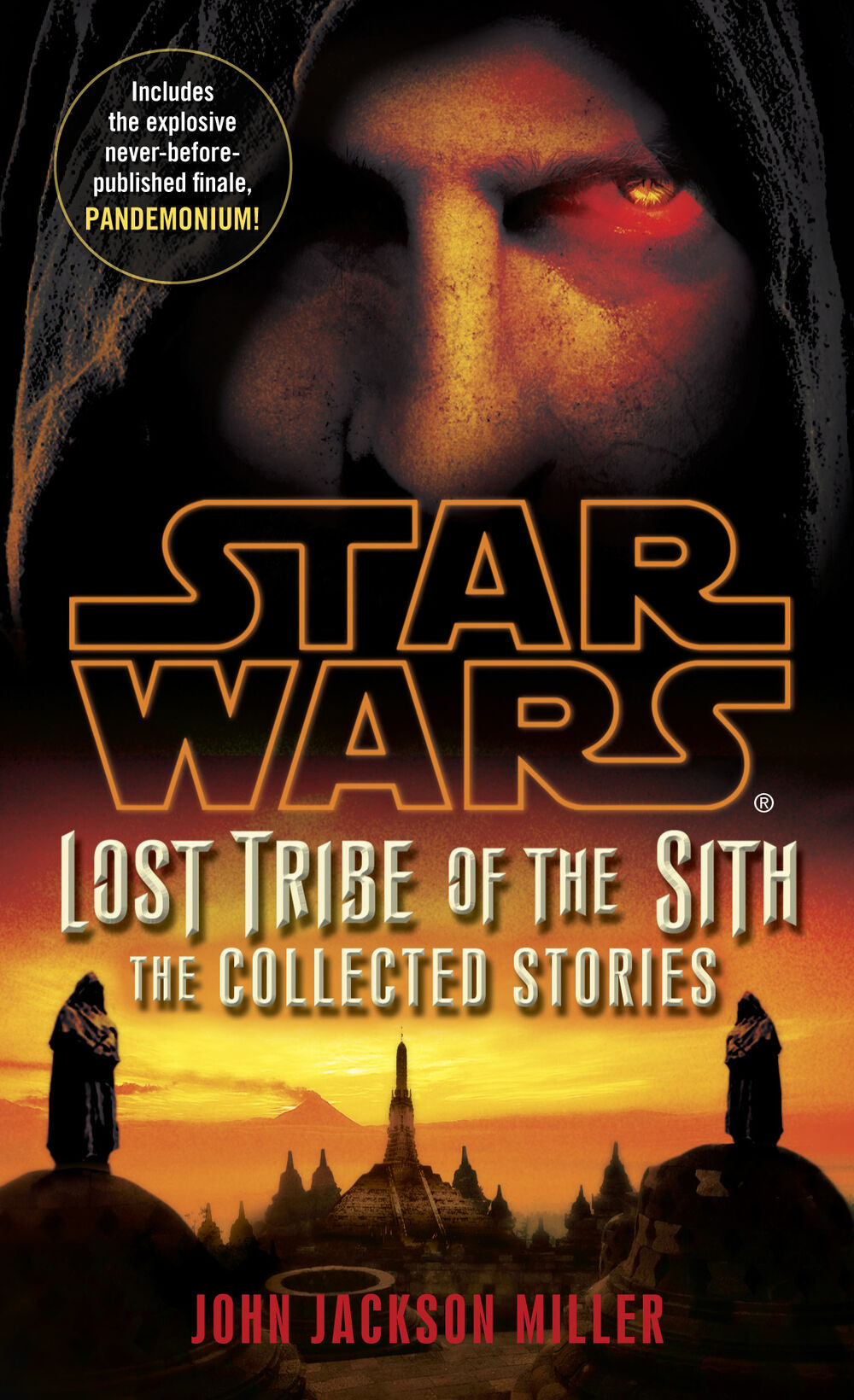
Review: Star Wars: Lost Tribe of the Sith: The Collected Stories


"It was our destiny to land on this rock—and we are bound to our destiny. For a time, it looks like, we're also bound to this rock. So be it. We're Sith. Let's make it ours."―Yaru Korsin

In May of 2009, Del Rey and Lucasbooks launched the first in a series of ebook novellas detailing the story of a Sith starship's crew and their crash landing on the planet Kesh.

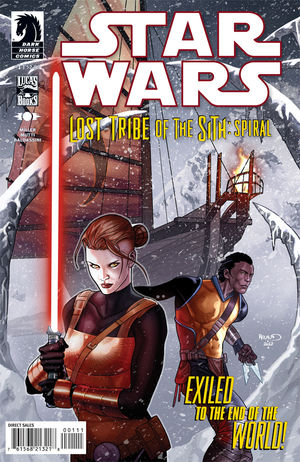
This series of ebooks detailed the exploits of what became known as the Lost Tribe, this group of Sith becomes marooned on a back-rocket planet circa 5,000 BBY.  While it began as a tie-in to the Fate of the Jedi series, the Lost Tribe of the Sith stories developed into a very compelling set of stories in their own right.

Publisher's Summary:

At last in one volume, the eight original installments of the epic Lost Tribe of the Sith eBook series . . . along with the explosive, never-before-published finale, Pandemonium—more than one hundred pages of new material! Five thousand years ago. After a Jedi ambush, the Sith mining ship Omen lies wrecked on a remote, unknown planet. Its commander, Yaru Korsin, battles the bloodshed of a mutinous faction led by his own brother. Marooned and facing death, the Sith crew have no choice but to venture into their desolate surroundings. They face any number of brutal challenges—vicious predators, lethal plagues, tribal people who worship vengeful gods—and like true Sith warriors, counter them with the dark side of the Force. The struggles are just beginning for the proud, uncompromising Sith, driven as they are to rule at all costs. They will vanquish the primitive natives, and they will find their way back to their true destiny as rulers of the galaxy. But as their legacy grows over thousands of years, the Sith ultimately find themselves tested by the most dangerous threat of all: the enemy within.


To be honest, on the whole I enjoyed the Lost Tribe much more than I enjoyed Lovecraftian villain Abeloth. What author and comic story writer John Jackson Miller does in this story is craft Dark Side Gilligan's Island or perhaps Lord of the Flies is a better comparison, either way we get a marooned crew of Sith which was a mixture of human and red skinned Sith (at least for a little while).  They crash on the planet Kesh, only two discover a native population with a mythology that is convenient and a lack of metal ore which is most inconvenient.

Without metal to build or repair their ship, the Omen, the Sith are faced with the fact that they have no choice but to remain on the planet.

This is where things get interesting, few in numbers the Sith must work together to wrestle control of the planet from the native population and in doing so create a very curious and unique Sith culture.

This volume is provided in trade paperback format (the same format that the Clone Wars Karen Miller books received).  This is purely personal preference but I detest this format.  I love hardcovers and like paperbacks, but I cannot get over the fact that my trade paperbacks do not stand up well to abuse.  The larger size of trade paperbacks makes them feel much flimsier then mass market paperbacks.  In addition to the different size, the trade paperback of this book carries a cover price of $12, while the recent Star Wars Mass Market Paperbacks are priced at $7.99. The book is also available as an ebook for the great price of $4.99.  Note: Amazon has not updated it's pre-order price and is still charging the $7.99 Mass Market price.


Note #2: Author John Jackson Miller points me to a new correct listing on Amazon.com that has the trade paperback edition for $7.80. Also if you are a Amazon Prime Member you can get 2 day shipping on the item for free. 

What we get in the book are the eight ebook stories, Precipice, Skyborn, Paragon, Savior, Purgatory, Sentinel, Pantheon and Secrets.  These amount to 255 pages of the book.  There is also an all new novella entitled, Pandemonium that weighs in at a meaty 128 pages.  The book also includes maps of two continents on Kesh, the continent that the Sith landed on Keshtah and a new continent that is introduced in Pandemonium, Alanciar. The last bit of added value is 19 page excerpt from Aaron Allston's upcoming novel X-Wing: Mercy Kill.

One of my favorite things about this series is that at times you can almost forget that the protagonists are evil, but then they display the callousness or casual brutality that can shock you out of liking these characters.  By crafting a rich Sith society and creating Sith characters of different types we get some very interesting story telling.

Pandemonium begins in 2,975 BBY and the over all effect of the series of stories is snap shots in history.  We get dropped in mid-story at momentous times in the history of the Lost Tribe, what happens in between is sometimes referred to but left to the imagination to fill in the dots.  By ending the story the way he does Miller also opens up some interesting story telling possibilities that he will continue in the new Dark Horse Comics which will debut on August 8th with Lost Tribe of the Sith #1. This continuation of the Lost Tribe tales represents the further integration of the Dark Horse comic and Del Rey novel lines and is a very positive thing for the Expanded Universe and fans of continuity.

I will admit I was a little worried about Pandemonium when I began reading it and started to wonder whether Nicholas Sparks had started writing Star Wars.  But the romantic story line involved is an interesting and humanizing way of introducing one of our main characters, Wardmaster Quarra Thayn.  I won't spoil the story for you, but it becomes a very interesting tale and we even get to see my favor "good" Sith Gand Master Varner Hilts return.

While I am not a fan of the format of this novel, if you like the Sith or simply like flawed and conflicted protagonists, John Jackson Miller has written a series of stories that are not to be missed.  Plus we get more maps, Star Wars maps are kriffing awesome.

For more on Lost Tribe of the Sith: The Collected Stories visit Random House and for more from author John Jackson Miller visit, Faraway Press.